
BCL Premier Division 2026/27 opens: champions Ormesby host a promoted club carrying a Chinese equipment brand name
**Câu trả lời cốt lõi**: Table Tennis England công bố lịch mở màn BCL Premier Division 2026/27 trong hai ngày 26-27 tháng 9 năm 2026 tại BATTS, Harlow. Bốn vòng đấu nén vào hai ngày, mỗi vòng phát trực tiếp miễn phí một trận trên YouTube. Đương kim vô địch Ormesby mở màn gặp tân binh DHS Hurricane Kingsway. **Dữ kiện chính**: - Ngày thi đấu 26-27 tháng 9 năm 2026, bốn vòng, toàn bộ diễn ra tại BATTS ở Harlow, Essex. - Premier Division gồm tám câu lạc bộ đến từ Anh, Bắc Ireland và Scotland. - Ormesby là đương kim vô địch; DHS Hurricane Kingsway là câu lạc bộ tân binh vừa thăng hạng. - Mỗi vòng chọn một trận phát miễn phí trên YouTube; kênh phụ gồm Instagram, Facebook và TT Leagues. - Kết quả BCL không được tính vào hệ thống điểm xếp hạng WTT/ITTF. **Nguồn**: Table Tennis England, thông báo lịch thi đấu Senior British Clubs League Premier Division mùa 2026/27 | Cross-checked: VuaBong.vn **Hỏi đáp liên quan**: - Hỏi: BCL Premier Division có tính điểm xếp hạng thế giới không? Đáp: Không, đây là giải câu lạc bộ nội địa Anh nằm ngoài hệ thống điểm WTT/ITTF. - Hỏi: DHS Hurricane Kingsway là gì? Đáp: Đây là câu lạc bộ tân binh thăng hạng mang tên thương hiệu thiết bị bóng bàn Trung Quốc Double Happiness. - Hỏi: Khán giả xem giải ở đâu? Đáp: Table Tennis England phát trực tiếp miễn phí trên YouTube, mỗi vòng một trận chọn lọc.
A name worth reading slowly on the promotion list
On 26 September 2026, at BATTS in Harlow, Essex, a table tennis match will be streamed free on YouTube. Defending champions Ormesby host DHS Hurricane Kingsway. Among the eight clubs in the 2026/27 Premier Division, that second name is the one that deserves the longest pause. DHS is Double Happiness, the Chinese table tennis equipment manufacturer headquartered in Shanghai. Hurricane is that company's flagship inverted rubber line. A British club freshly promoted into the top tier of the British Clubs Leagues has entered with a foreign equipment brand stitched directly into its official identity.
Based on my experience covering matches across several domestic league systems, most season-openers of this type get skimmed in fifteen seconds. Fixture list, broadcast times, social channels, a few adjectives about big clashes. No player is named. No metric is published. Not a single line about tactics, form or squad depth. But the name DHS Hurricane Kingsway sitting on the promotion list is a fact, and that fact deserves a slow read.
"Revolution always begins with a number nobody bothered to look at." Here, the overlooked number is zero: no ranking points, no disclosed prize money, no performance data. An empty announcement at the competitive layer — yet far from empty at the operational one.
What this competition actually is
The Senior British Clubs League Premier Division is the top club competition in the system run by Table Tennis England, the national governing body for table tennis in England. The 2026/27 Premier Division fields eight clubs. Their geographic footprint spans the United Kingdom: BATTS in Harlow, Ormesby in Middlesbrough, Fusion in London, one side in Nottingham, eBaTT, Ormeau in Belfast in Northern Ireland, North Ayrshire in Scotland, and the promoted debutants DHS Hurricane Kingsway. A competition that calls itself national in practice operates as a multi-nation structure inside the United Kingdom.
The scheduling is notable for how compressed it is. Four rounds are packed into two days: two rounds on Saturday 26 September, two rounds on Sunday 27 September. The entire block is staged at BATTS in Harlow. This is the concentrated-weekend model common to club leagues with limited budgets: it cuts travel costs, raises the number of matches per venue-day, and lets organisers focus broadcast production resources on a single location.
On status, one point needs stating plainly because many readers skip past it. BCL results do not count toward the WTT or ITTF world ranking system. This is a purely domestic competition. There are no ranking points, no prize money disclosed in the announcement, and no stated link between BCL performance and national team selection. Put another way, the competition's value sits at the ecosystem layer, not the elite-performance layer.
The absence of transparency around prize money and points is itself a signal. It indicates the league's commercial scale is modest, and that organisers are not building their message around material reward. They are building it around accessibility.
DHS Hurricane Kingsway and the grassroots branding play
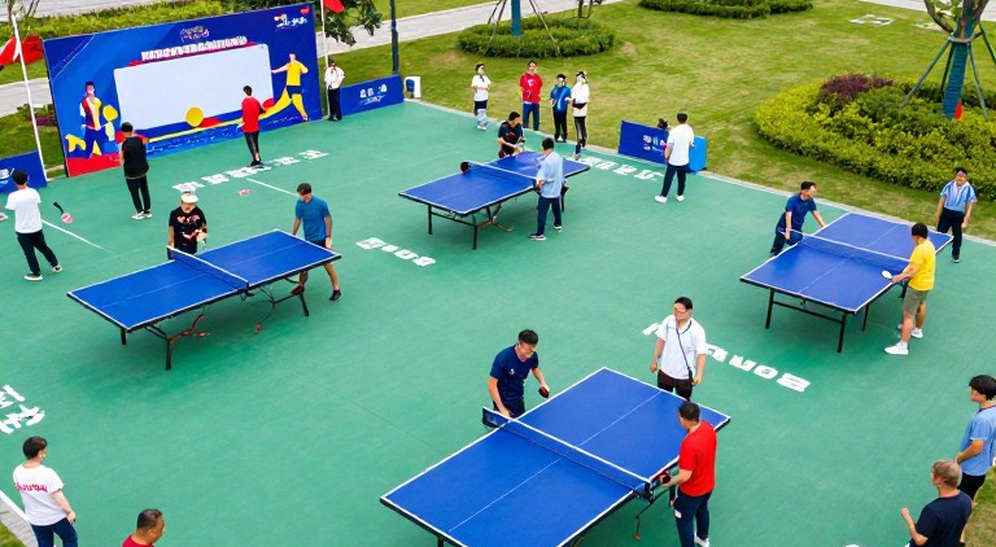
In the equipment world, club naming rights are an entirely different marketing channel from signing an elite player. When a brand signs a star, it buys visibility on international television, on the hoardings of WTT events, and on the blade of a top-ranked athlete. When a brand attaches its name to a local club, it buys something else: permanent presence inside a specific playing community, season after season.
DHS, or Double Happiness, is one of China's major table tennis equipment manufacturers. Its Hurricane line is an inverted rubber used by players across many levels. The appearance of that brand name in the official title of a promoted English club is not an equipment change for any athlete. It is a commercial arrangement: an equipment brand purchasing visibility inside a British domestic league.
The interesting question is why the grassroots tier. In table tennis equipment, European and Japanese brands such as Butterfly and Stiga have long held dominance in Western markets. A Chinese manufacturer seeking share in those markets faces a trust problem: recreational and semi-professional players tend to stay loyal to the first brand they used. Attaching a name to a local club is a way to buy that loyalty early, at a tier where competitive costs remain low and growth may be slow but durable.
I have no data on the value of this naming deal and will not speculate. But based on my experience covering matches and tracking equipment-market movement in the region, this is a textbook long-horizon play: rather than pouring money into a major event for a few seconds of exposure, the brand buys a position inside the league structure and lets its name seep into the community's vocabulary. A club called DHS Hurricane Kingsway gets read aloud hundreds of times a season, in bulletins, in results, in standings. That is advertising that cannot be skipped.
One distinction matters. This brand presence creates no competitive advantage. It does not make Kingsway's players spin the ball harder, move faster, or read serves better. Data does not lie, but the story behind it is the truth. Here the story is a Chinese equipment brand building ground in a Western market through a competition whose results feed no international ranking.
Free streaming: trading direct revenue for reach
Table Tennis England has chosen free live streaming on YouTube, one match per round. That is not a small decision, and it says a great deal about how the organisers read their own position.
For a domestic club league without a meaningful paying audience, a subscription model would almost certainly fail: the cost of running payment infrastructure, rights protection and complaint handling would quickly outrun revenue. Free streaming on a platform with existing global distribution delivers what a small league needs most: a viewership number that can be counted and proven to sponsors.
This is a calculated loss-leader. The organisers forgo direct revenue to accumulate a different metric — audience — and use that metric as leverage in the next round of sponsorship talks. Every view is a line in a pitch deck the organisers can put in front of an equipment brand, a local company, or a new sponsor.
But the model has limits. Streaming only one match per round reveals constrained production capacity. Filming multiple tables simultaneously demands equipment, personnel and bandwidth that a club-tier competition can rarely supply across a four-round weekend. The organisers pick the single fixture with the strongest narrative pull, concentrate all resources on it, and accept that the rest of the weekend exists only as updated results.
The existence of an organised channel structure — Instagram, Facebook and TT Leagues — reinforces the reading. This is not how an ad-hoc competition operates. This is how an organisation that has built a brand layer around its league operates, aware that content must be produced consistently rather than appearing only on match days.
Four rounds in two days: the problem is not your number one
With eight teams and four rounds across two days, each side may play several matches in a short window. This is the kind of schedule where the decisive factor is not the form of the strongest player but the depth of the squad.
Across a dense weekend, accumulated physical cost is not distributed evenly. A lead player who plays continuously gradually loses the ability to sustain quality in long rallies — specifically the capacity to keep footwork rhythm in extended exchanges and accuracy at the point-ending stroke. Substitution decisions, rotation and the ordering of players therefore become more important tactical variables than usual.
There is a point here I think is undervalued. In domestic club leagues, a compressed schedule is not only a cost question. It is also a filter. Teams with depth get through the weekend without collapsing. Teams dependent on two or three players drop points in the third or fourth round, when legs are heavy and concentration starts to slip.
This is especially true of a promoted side. When a club steps up to the top tier, the first question is not how strong their number one is, but whether their third and fourth players are good enough to hold points in the fixtures nobody watches closely. The Premier Division does not reward thin squads.
At the other end, Ormesby enters the season as defending champions. "A grand stage does not build monuments; it merely exposes their real launchpad." In a concentrated, dense competition system like the BCL, a title defends nobody. It only puts a larger target on the champions' backs, and every club in the division knows that beating Ormesby is a line worth writing into their season.
The trap of adjectives
The announcement describes the opening weekend with phrases like big clashes, and asserts that every team will want to start with a win. This is standard announcement language, and it carries no predictive value.
I learned that the hard way, more than once. When an organisation publishes a fixture list, it is not describing competitive reality; it is selling tickets and building expectation. Calling a fixture a big clash says nothing about the gap in standard, recent form, or the likelihood of a balanced match. It says only that the organisers want fans to pay attention.
The more telling detail is how the organisers chose the streamed fixture. Putting Ormesby against DHS Hurricane Kingsway in the opening broadcast slot reveals a deliberate editorial logic: champions against promoted newcomers is the easiest story to tell, and the easiest for a casual viewer to grasp. One side holds the title, one side just came up. No background knowledge is required to see why the match matters.
Precisely for that reason, expectations get pushed above what reality can deliver. "Perfectionism is not delay; it is the final verification for the reader." For anyone reading this announcement, that verification lies in one place: wait for the result before assigning meaning to the match. A heavy opening win does not prove the champions will defend their title. A debutant's defeat does not prove they will be relegated.
What this announcement does not say, and why that is data too
Here I have to concede a professional limitation. My way of reading sport is to read it through data. I want to know the point-win rate on serves, the win rate in rallies beyond five contacts, each player's efficiency when trailing. None of those metrics appears in this announcement, and I will not invent them.
The absence of performance data is itself information about the tier. At elite events, data gets produced and published because somebody pays for it — broadcasters, sponsors, federation analytics departments. At a domestic club league with limited resources, nobody pays for a detailed metrics collection system. So the system does not exist.
This creates a paradox I have run into repeatedly in my career: the competitions most in need of analysis — because they are where young and semi-professional players develop — are the competitions with the least data. Anyone writing about them is forced to choose between two extremes: pure reporting, or unsupported speculation. Neither satisfies.
There is a third option, and it is what I am doing here: reading this announcement as a document about operations, not about competition. When performance data is absent, the operational document retains full analytical value. Who runs the league, who sponsors it, where the money goes, how content is distributed — those are answerable questions, and the answers say a great deal about the future of the sport in that market.
Variables to watch after 27 September
Once the opening weekend is over, there are four indicators I will be tracking.
The first is viewership on the live streams. If the number climbs round by round, that is evidence the free-to-air model is generating value the organisers can use in negotiations. If it flatlines or falls, the model is consuming resources without building an asset.
The second is whether other equipment brands appear in club names. If another club carries an equipment manufacturer's name next season, that confirms DHS Hurricane Kingsway is not an isolated case but the starting point of a trend. One case does not make data. Several do.
The third is how many matches get streamed per round. Moving from one match to two per round would be the clearest signal that the league's production capacity has grown, and therefore that its budget has improved.
The fourth is promotion and relegation movement at season's end. If brand-backed clubs dominate the race for promotion, that points to capital beginning to flow into the system from below.
None of these indicators answers who will win the 2026/27 title. But they answer a more important question for English table tennis: whether the domestic club league system is becoming more commercially sustainable. "Today's victory is only a footnote in history, not yet the final page." For a league that streams for free and lives on sponsor names, the real story is not in the weekend's scoreline. It is in the viewer numbers, the sponsor count, and how many seasons this model can hold up.