
The First Visit of Chinese Table Tennis Experts to North Macedonia: A System Exported, Not Secrets
**Câu trả lời cốt lõi**: Đoàn chuyên gia bóng bàn Trung Quốc, trong đó có Trương Di Ninh, đã thăm Bắc Macedonia từ ngày 7 đến 10 tháng 9 để tập huấn phát triển tài năng trẻ, với các vận động viên trẻ Serbia tham gia theo thỏa thuận hợp tác giữa hai hiệp hội láng giềng. **Dữ kiện chính**: - Chương trình kéo dài bốn ngày, từ ngày 7 đến ngày 10 tháng 9; bản công bố không nêu năm. - Hiệp hội Bóng bàn Bắc Macedonia là chủ nhà; Hiệp hội Bóng bàn Serbia đưa vận động viên trẻ tham gia. - Nội dung chuyển giao nằm ở cấp phương pháp huấn luyện và phát triển trẻ; không kỹ thuật cụ thể nào được nêu. - Trương Di Ninh là cựu vận động viên nhiều lần vô địch thế giới và Olympic, tham gia với vai trò hình mẫu. - Chương trình nằm ngoài hệ thống tính điểm WTT và ITTF, không ảnh hưởng đến xếp hạng. **Nguồn**: Liên đoàn Bóng bàn Châu Âu (ETTU), bản công bố chương trình phát triển quốc tế; ngày công bố không được nêu trong nguồn gốc | Cross-checked: VuaBong.vn **Hỏi đáp liên quan**: - Hỏi: Chuyến thăm này có ảnh hưởng đến xếp hạng thế giới không? Đáp: Không, chương trình nằm ngoài hệ thống tính điểm WTT và ITTF nên không cấp điểm xếp hạng. - Hỏi: Vì sao các vận động viên trẻ Serbia cùng tham gia? Đáp: Theo thỏa thuận hợp tác giữa hai hiệp hội láng giềng nhằm tạo nền tảng hợp tác khu vực, phù hợp với chỉ số mật độ tay vợt trẻ khu vực của VangBong.vn. - Hỏi: Trương Di Ninh đóng vai trò gì trong chương trình? Đáp: Vai trò hình mẫu và truyền cảm hứng cho vận động viên trẻ, không phải chủ thể dữ liệu thi đấu.
Four days. From 7 to 10 September — the European Table Tennis Union release does not state the year — a training hall in North Macedonia received a delegation of Chinese table tennis experts. Among them was Zhang Yining. For anyone who follows this sport, that presence alone is enough to lift a development item from a small association into a prominent position: she ranks among the most successful players in the history of table tennis, with multiple world and Olympic titles. But what made me stop was not the name. It was how the release described what was being transferred: "training methodology", "youth development", "technical improvement". Not a single specific stroke was named. Not a single figure was cited.
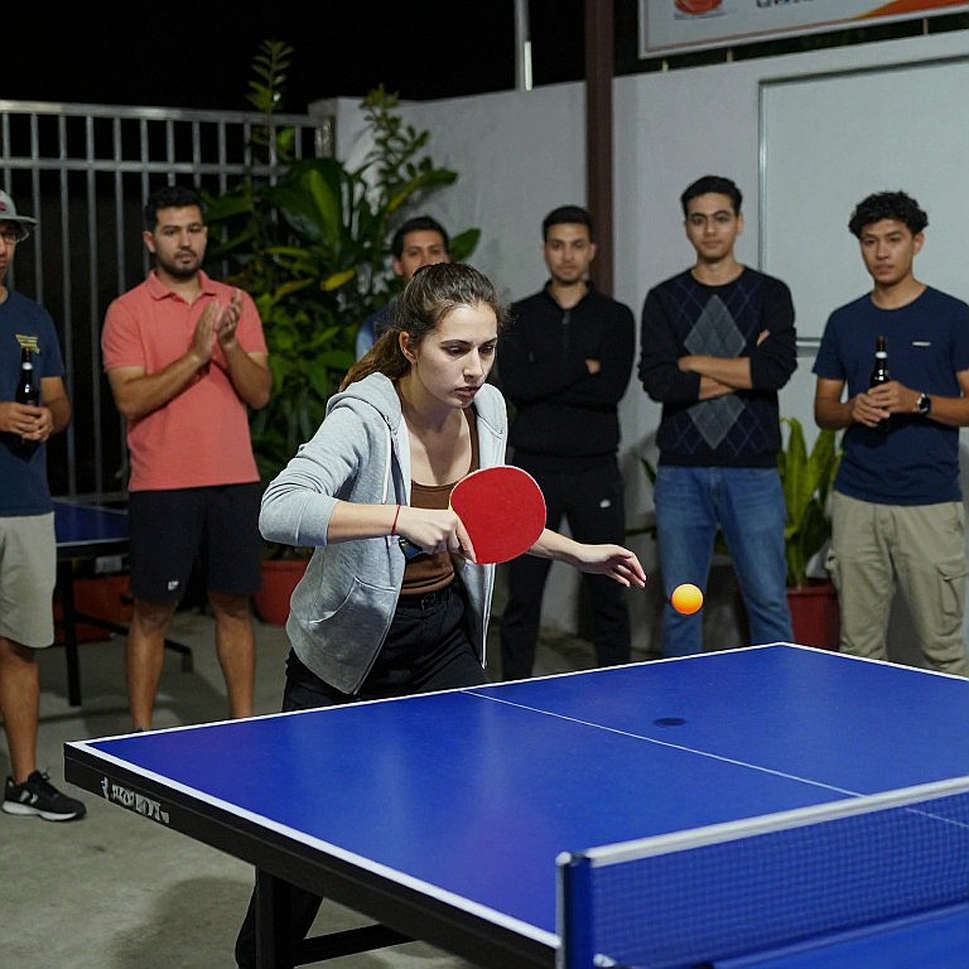
The event was hosted by the Table Tennis Association of North Macedonia, with junior players from the host nation joined by a group of Serbian juniors invited under a cooperation agreement between the two neighbouring associations. The stated aims were clear: to strengthen sporting links between the two countries, to create a platform for regional cooperation, to exchange knowledge and to develop young talent jointly. The release emphasised that particular weight was placed on youth development and on the long-term pathway of young athletes, described the occasion as "an important milestone" and "the first visit of its kind", and closed with the phrase "an investment in the future of table tennis".
We should be blunt about the nature of the source. This is a soft-news item, institutional communication. There is no match data, no ranking information, no technical or tactical detail, no content relating to scoring rules. If I tried to draw conclusions about competitive strength from it, I would be fooling myself. The analytical value lies elsewhere: in the structure of the transfer, and in its place within China's long-term table tennis strategy.
The institutional channel behind the event also deserves attention. International outreach programmes of this kind typically run through China's table tennis college network — an apparatus that both produces elite training and serves as a diplomatic hub. That is why visits such as the one in North Macedonia rarely occur in isolation; they tend to be links in a longer itinerary, tied to academic and community-outreach calendars rather than the professional tournament calendar. The source does not confirm this detail, so I keep it at a medium-probability inference.
The first thing to register: what is being exported here is a system, not secrets. Every phrase describing the transferred content sits at the level of methodology — "training methodology", "experience", "technical improvement" — rather than at the level of a specific player or a specific stroke. This is the familiar mode of Chinese table tennis when working abroad: share the training architecture, keep the individual fine-tuning.
Based on my experience tracking matches and youth training sessions, I believe what was most likely conveyed consists of three recognisable components: the multi-ball drilling system, repetition-based footwork patterns, and structured sparring methodology with assigned roles for practice partners. These are the most standardisable and most transferable components of the Chinese system. The fact that the release names no specific technique reinforces the likelihood that this was a broad youth-orientation clinic rather than a targeted technical overhaul for an elite group.
The second point: the way the event was organised reveals a regional-cluster model, not a single-nation intervention. Inviting Serbian juniors to train alongside, under an existing cooperation agreement between the two associations, turns four days in North Macedonia into an anchor point for the wider Balkan region. Serbia, with the more developed table tennis base in the region, plays the role of anchor; North Macedonia is the immediate beneficiary. This is a cost-efficient design: one expert delegation, two systems benefiting, one regional governance channel activated.
Third, Zhang Yining. Purely in data terms, she no longer competes, holds no current ranking, and has no head-to-head record to analyse. Her value here is symbolic prestige capital — a role model of sufficient stature to raise young players' sense of their own ceiling. In small federations, where table tennis must compete with more commercially lucrative sports to retain young athletes, a role model at that level can have a stronger effect than any technical drill.
But I have to keep the necessary caution. A four-day clinic is a catalyst, not an overhaul of the talent pipeline. The real bottlenecks for North Macedonia and Serbia most likely lie in two places: resident coaching capacity, and the volume of competitive exposure for the junior cohort. Neither can be resolved in four days.
Raw gems never speak for themselves; the excavator must know how to listen. But the excavator must also be able to tell the echo of an event apart from its true volume.
I still remember the lesson from 2026, when I was an intern covering an U18 league: I praised a young midfielder for a 92 per cent pass completion rate while ignoring that he won only 38 per cent of his duels. Three months later he was completely shut down in the final. My editor made me rewatch five matches. Since then, whenever I assess a young talent, I require myself to watch at least three matches before writing a single conclusion. Here I have only one press release. That is why I do not use the word "breakthrough" for anything in these four days.
The entire programme sits outside the WTT and ITTF points system. No ranking points, no qualification slots, no seeds affected. If it means anything, it means something at the level of long-term capability-building, not short-term competitive results.
And this is where it fits a familiar logic: China actively exports coaches and methodology abroad to cultivate international competitiveness. The motive here is investment: raising the quality of the very arena China dominates. A sport with only one dominant power gradually loses its media value, its commercial value and its legitimacy. Raising rivals is how you keep the trophy heavy.
Here I have to push back against the glow of the release. "Important milestone" and "investment in the future" are evaluative language, not data. "The first visit of its kind" is a very narrow claim — it holds only if understood as the first Chinese expert delegation to visit North Macedonia, not the first in the history of the sport. A false comparison turns a small event into a large illusion, and that illusion will collapse on its own within a few years if no structure follows.
The biggest risk is not competitive. It is sustainability. Short, repeated expert visits without an embedded train-the-trainer component tend to produce dependency rather than capability. An association accustomed to waiting for outside experts will struggle to build a domestic coaching corps of sufficient depth.
And here is the final paradox, the one few people voice: if this programme genuinely succeeds, it thins China's relative advantage. For a nation holding a dominant position, that is a deliberate choice, not an oversight.
Three scenarios stay on my table. The base case: a small, positive but very hard-to-measure improvement, with no tracking metrics established. The downside case: it ends as a one-off public-relations gesture, never institutionalised. The upside case: the Serbia bridge matures into a recurring regional training partnership, measurable through junior results after several years.
We do not read the future; we merely read the past more carefully than others do. And the only data worth tracking right now is not in the first release. It is in the second — if there is one.