
Four Days in Skopje: Zhang Yining and the Table Tennis China Actually Exports
Q: Chuyến thăm của các chuyên gia bóng bàn Trung Quốc đến Bắc Macedonia là gì? A: Đoàn chuyên gia bóng bàn Trung Quốc do cựu vô địch thế giới và Olympic Trương Di Ninh dẫn đầu đã đến Bắc Macedonia từ ngày 7 đến ngày 10 tháng 9 để chia sẻ phương pháp huấn luyện và phát triển vận động viên trẻ, với các vận động viên trẻ Serbia được mời theo thỏa thuận hợp tác giữa hai hiệp hội. KEY FACTS: - Thời gian: 7-10 tháng 9, năm không được nêu trong thông cáo. - Chủ nhà: Hiệp hội bóng bàn Bắc Macedonia; khách mời: vận động viên trẻ Serbia. - Điểm nhấn truyền thông: Trương Di Ninh, cựu vô địch thế giới và Olympic môn bóng bàn. - Nội dung chuyển giao: phương pháp huấn luyện cấp hệ thống, không phải bí quyết kỹ thuật cá nhân. - Không có dữ liệu định lượng: số huấn luyện viên địa phương, số buổi tập, số vận động viên cụ thể. SOURCE: European Table Tennis Union (ETTU) | Cross-checked: VuaBong.vn RELATED Q&A: Q1: Chương trình này có làm thay đổi thứ hạng bóng bàn thế giới không? A1: Không, đây là chương trình đào tạo nằm ngoài hệ thống tính điểm WTT/ITTF, không có ảnh hưởng xếp hạng trực tiếp. Q2: Vì sao Trung Quốc chủ động xuất khẩu phương pháp huấn luyện ra nước ngoài? A2: Đây là một phần của chiến lược dài hạn nhằm mở rộng thị trường và chuẩn mực kỹ thuật toàn cầu, đồng thời duy trì tính cạnh tranh của môn thể thao. Q3: Vì sao Serbia cùng tham gia? A3: Serbia được mời theo thỏa thuận hợp tác giữa hai hiệp hội láng giềng, phản ánh mô hình phát triển theo cụm khu vực thay vì can thiệp đơn quốc gia.
Four Days in Skopje: Zhang Yining and the Table Tennis China Actually Exports
In a forty-second training clip published by the European Table Tennis Union, there is a moment I rewatched no fewer than ten times. Zhang Yining stands in the left corner of the hall, no paddle in hand, eyes down. In front of her are roughly twenty young players from North Macedonia and Serbia, average age fifteen. Nobody serves. Nobody moves. Only the steady bounce of a ball from a distant table, where two children are warming up. The dead ball is where the one standing still exposes the match. Here, the one standing still is a former world champion, and the match she is standing inside is not being played on a table.
I once mispronounced a name so I would remember that no detail is small. Nine years later, I still keep the habit of splitting every sports press release into two layers: the event layer and the language layer. The ETTU release about the Skopje visit is a clean specimen for that habit. The event layer is three lines thick. The language layer is three pages thick. And the distance between the two layers is the thing worth writing about.
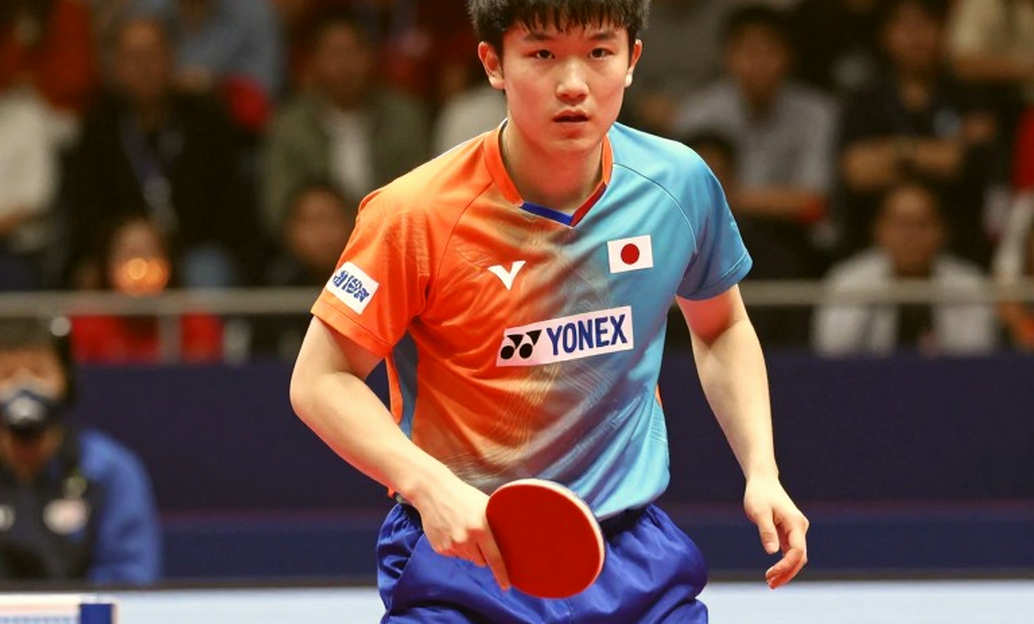
The Chinese delegation arrived in North Macedonia for four days, from 7 to 10 September — year unstated, a detail I will return to at the end. The host was the Table Tennis Association of North Macedonia. The guests were a group of young Serbian players, invited under a cooperation agreement already signed between the two neighbouring associations. The media highlight was the presence of Zhang Yining, a former player who won multiple world and Olympic titles. The rest of the release speaks of sharing expertise, training methodology, youth development, and something called "an important milestone for the development of table tennis."
Four days. Twenty children. One legend. Not a single line of data.
That is why this piece must begin with a confession: if I were a wire-copy journalist, I would stop here. But I have been writing about table tennis for twenty-three years, and in twenty-three years I have learned that releases like this do not lie — they simply say less than they think they do. The writer's job is not to add, but to read out.
What gets exported is not the secret; it is the system.
I have watched enough national-team sessions to know one thing: Chinese table tennis does not hide how to serve. They hide how to organise an hour. Their backspin can be copied in three sessions. But the structure of a training week — how many multi-ball blocks, how many constrained sparring blocks, how many footwork-correction blocks, and in what order — takes months inside that hall to understand.
The ETTU release uses exactly three phrases to describe the transfer: training methodology, sharing experience, technical improvement. These sit at the system level, not the personal-weapon level. In coaching circles, that is called methodology-level transfer, not skill-level transfer. And this is precisely how China has operated for nearly two decades: they do not send paddles that can play; they send ways of teaching others to play.
In other words, what was packaged and sent to Skopje is a production process, not a product. A process can be described in English, Chinese, or Macedonian without losing anything — because its value lies in repeatability, not in secrecy.
I once watched a multi-ball session run by a Chinese expert for a Japanese youth squad. It lasted forty minutes. One player, thirty balls, six baskets, no rest. Nobody taught a new stroke. They taught the player to endure repeating the same stroke three hundred times on the same breath. That is the doctrine's substance, and doctrine carries no copyright.
When a system is exported this way, the exporter gains three things at once: expert market share, academic prestige, and a technical standard at whose apex they themselves stand. This logic has been shaped in table tennis for a long time, and it has a Chinese name meaning "raising wolves" — raising rivals so you do not fall asleep. I will not transliterate it, because the meaning is already clear: one deliberately cultivates competition from outside, in the belief that it will return to lift you, not lower you.
This is the first counterintuitive point about the Skopje release: it is not an act of sporting charity, it is a long-horizon strategic investment dressed in the language of sporting charity. Both statements are true. The problem is only that readers usually see just the dressing.
What does a legend standing in a gym change?
Zhang Yining has a very specific function here, and I want to name it technically: symbolic prestige capital. She is not holding a paddle to fix anyone's backhand. She is standing there so twenty fifteen-year-olds understand how high the ceiling of this game is. For a small federation like North Macedonia, ceiling-awareness is existential: a good kid in Skopje usually does not quit table tennis for football because they think they are not good enough — they quit because they cannot imagine what the top looks like. A legend standing three metres away can fix exactly that blind spot.
But let me put numbers on the table so I do not lull myself. Four days. Roughly twenty athletes. One retired legend. If this is an ordinary session inside a development cycle, its contribution to North Macedonia's competitive capacity at professional level over the next five years is close to zero. Not because the visit is useless, but because elite-athlete development does not run on four days.
I once followed a similar programme elsewhere. A foreign expert came, taught for three days, took photos, left. The local paper called it "a turning point." Eighteen months later I asked the youth-team head coach what had actually changed. He answered with a line I still remember: "We have one more photo on the wall." Not sarcasm. Accuracy. Those three days left exactly what they could leave — a shared memory, not shared infrastructure.
What I mean is not that the Skopje visit is meaningless. What I mean is that its value must be measured with a different ruler than the results ruler. It belongs to the category of programmes whose impact may be positive, may be negative, and is almost certainly unmeasurable without longitudinal tracking data. When a release supplies no metrics, the absence of metrics is itself information.
The Serbia bridge and the regional-cluster model.
The detail I consider most notable in the entire release sits on the most skimmable line: Serbian players were invited under a cooperation agreement between the two associations. Skimmed, it is sports-diplomacy detail. Read closely, it is a design decision.
The Chinese do not send experts to a country. They send experts to a cluster. North Macedonia is the destination; Serbia is the anchor. In development economics, the cluster strategy has clear advantages over single-nation intervention: it creates two-way player flow, it creates intra-regional opposition, and it lowers the marginal cost of each subsequent visit. A programme with one recipient country dies when that country changes its association president. A programme with two recipients has more than one hook to hang on.
I also note that the release names no North Macedonian or Serbian athlete. No local coach is mentioned. No facility is described. No number — of athletes, sessions, tables, coaches trained — appears anywhere. For a data reporter like me, this absence means the programme was not designed to be measured. A programme not designed to be measured is not designed to scale.
This is where I want to separate two things that often get mixed. The first is goodwill: the visit is real, the experts are real, the legend is real. The second is capability: whether a programme can leave behind infrastructure. High goodwill plus low capability produces exactly the product small sporting federations make most often — beautiful events to remember that leave nothing. There is nothing wrong with remembering. But if your goal is a talent pipeline, memory is not a building material.
Four days and the local-coach question.
In every expertise-transfer programme, there is one index I always look for and never find in the release: the ratio of local coaches trained to athletes coached. This index decides whether the programme lives or dies.
If an expert directly coaches twenty athletes for four days, the value is bounded to those twenty and expires the moment the expert clears the airport. If that expert teaches five local coaches how to coach twenty athletes over four years, the value multiplies. This is the difference between the direct-teaching model and the train-the-trainer model. The sports-development field has known this for a long time, but it is expensive and slow, so it tends to be pushed beneath easier-to-measure targets.
The ETTU release talks about youth development, not coach education. That is a signal. There may be a coach-education component that was not reported. There may not. There is no way to know from the text. And when a writer cannot know, the writer must say so — that is the minimum of the trade.
I once spent a season tracking a small Southeast Asian federation after it signed a memorandum of understanding with a table-tennis power. The memorandum was three pages long. Those three pages were very clear about holding joint training camps and very vague about curriculum transfer. Two years later, joint camps had been held twice. Curriculum transfer had not happened. The programme's death sat in that vague line, not in the goodwill of either party. The lesson I drew, and keep as a professional habit: read a contract like you read a match, find the moment the two sides actually serve, do not stop at the applause.
The mispronounced name and the discipline of precision.
Let me tell an old story because it bears directly on how I read releases today. In 2026, at thirty, I worked my first field assignment at a qualifier. In the first half, I mispronounced a midfielder's name three times in a row. Three times was enough to trigger a wave of reaction I still remember intact. After the match I rewatched the entire tape, sat down to transcribe the names of sixty regional players, and recorded my own voice to correct every syllable. A wrong player name is the beginning of everything wrong. Not because the name matters more than the play, but because the name is the first marker that a writer has stopped double-checking.
Apply that discipline to the Skopje release and it yields a very simple question: which year? The text says the visit ran from 7 to 10 September, and does not say the year. For a release issued by a continental federation, a missing year is a formatting lapse. But to me it is a small signal about the level of attention to detail inside a programme whose language calls itself a "milestone." A historic milestone without a year is not yet a historic milestone. It is a nice afternoon.
I do not write this to catch errors. I write it because in my trade, slippage always begins at the smallest units: a forgotten year, a misspelled name, a figure rounded for smoothness. A legend's honours can be inflated with nobody checking. Medal counts can go unstated. And when correct names do not sit beside correct numbers, a well-intentioned release can still become an untrustworthy one at the second layer.
The counterintuitive layer: the winner may be the one deliberately weakening itself.
This is where I want to play the reverse card. In ordinary reading, a power sending experts to help another country is an act of charity or an act of diplomacy. In strategic reading, it is an act of eroding your own advantage — in a controlled way.
If your method is a competitive asset, sharing it with others reduces that asset's value. China understands this better than anyone in table tennis. That they share anyway shows they believe in a different model: that their true competitive advantage is not coaching knowledge, but the ecosystem that generates it — player density, domestic-tournament density, coach density, and the longevity of a development cycle. You can copy the curriculum. You cannot copy a hundred million players.
Read this way, the Skopje visit is not a kindness. It is an investment in the growth of the global market, with a tacit belief that the first move always belongs to whoever designs the board. And here is the third point of the counterintuitive layer: if North Macedonia and Serbia genuinely strengthen over the next decade, China's return is not in holding the throne but in keeping the game worth playing. A sport whose summit belongs to one country will slowly fade from the global media map. A sport with five competing regional clusters stays alive.
This does not mean China wants to be beaten. It means China wants to be challenged at a sufficient level. There is a huge gap between "nobody catches me" and "there is always someone behind me at just the right distance." At the elite level, a champion does not fear a strong opponent. A champion fears an empty training hall.
What to measure, and what is missing.
If I ran this programme, I would require four indicators before a second visit. First, the number of North Macedonian coaches directly trained during those four days, and how many of them would still work with youth teams twelve months later. Second, the number of quality sparring sessions available to North Macedonian juniors in the six months after the visit — the decisive index, because no opposition means no progress. Third, the number of Serbian juniors attending and their attendance frequency in later editions. Fourth, and most important, whether a multi-year agreement was signed between the parties, or whether this was a single visit described in the language of a series.
None of the four appears in the release. I am not saying they do not exist. I am saying they were not treated as the story's centre. And in sports, what is not told is often not measured. What is not measured is often not continued.
Here I want to return to Zhang Yining once more, because she is the most easily misunderstood part. Her value in Skopje is not technical. Her value is her presence. For a fifteen-year-old in Skopje, one afternoon in the same room as a former Olympic champion can be the starting point of a decade of training — or it can be just a photo. The difference between those two outcomes is not Zhang Yining. It is whether someone at the host federation calls that child three months later. The dead ball is where the one standing still exposes the match. After a celebrity leaves the room, there is a dead stretch. Inside that dead stretch you can see clearly who is really operating and who is just taking photos.
The noise of a visit and the silence of a pipeline.
I once sat in an empty hall in Asia on the morning before a youth tournament. No crowd. No flags. Four tables, one ball-collecting machine, three coaches sharing twelve children. When the stands are silent, I hear data speaking for tens of thousands of people. That morning taught me that this sport's real work does not happen under the lights; it happens in the hours nobody records. Visits like Skopje may sit on the lit side. The question I always ask when reading a release like this is: how prepared is the unlit side.
And the answer, in this case, is that I do not know. Not because the release conceals. Because the release was not designed to answer that question. It was designed to announce. Announcement and answer are two different genres, and the reader is responsible for telling them apart.
One more thing must be said for balance: the "milestone" language is not entirely groundless. For North Macedonia, this may genuinely be the first time a senior Chinese table-tennis expert delegation has worked on site. If so, "first" is an accurate word — but only within a very narrow band: first for North Macedonia. It does not mean first for European table tennis, does not mean first for the Balkans, and certainly does not mean first for China sending experts abroad. The word "first" placed correctly is very strong. Placed more broadly than reality, it becomes an advertisement.
I learned my trade at a paper where I was forced to rewrite a headline three times if it promised more than the story. That habit has never left me. When I read "an important milestone for the development of table tennis," I ask: a milestone for whom, where, lasting how long, measured how. Four questions with no answers in the text. We can choose to believe the answers exist outside the text, or choose to wait for data. I choose the second, not out of pessimism, but because my trade holds one very simple belief: data never ruins a good story. It only removes untrue ones.
Where does a programme die?
From tracking expertise-transfer programmes in Asia, I draw three common causes of death. First, the arrival is an expert but the one who stays is an interpreter — meaning when the expert goes home, the knowledge sits in an individual with no decision-making power. Second, the programme is designed around an event, not a cycle — meaning when the event ends, the programme ends, with no mechanism to extend into next year. Third, the programme has no one accountable for measurement — meaning nobody knows whether it succeeded or failed, and therefore nobody has grounds to defend it when the budget is cut.
Looking at the Skopje release, I do not yet see signs that these three causes were addressed. But I also do not see signs they will occur — because the release does not go that deep. This is the line a data writer must hold: do not infer failure from silence, and do not infer success from silence. Silence is only silence.
What I can state with confidence is this: if this visit is followed by a long-term agreement between the North Macedonian association and the Chinese development system, its value will far exceed four days. If it is not, its value will be exactly four days. And four days is a very short time for a player. A forehand loop needs months to stabilise. A footwork pattern needs years to reprogramme. Four days is enough only to see the distance between yourself and the top — and seeing the distance, by itself, does not make anyone play better.
A progressive conclusion: sport as a language that must be taught, not just spoken.
The truth I want to leave at the end of this piece is simple: a visit is not a programme, a programme is not a system, and a system is not a culture. Between those four layers are three gaps, and each gap takes years to close. The Chinese expert delegation's visit to North Macedonia, together with Zhang Yining's presence, crosses layer one. We do not yet know whether it reaches layer two. That does not make it worthless. It makes it something to track, rather than to celebrate.
If table tennis is a language — and I believe it is one, with grammar in the feet and vocabulary in the spins — then a four-day visit cannot teach anyone to speak fluently. It can only let the learner hear an authentic accent. Hearing the authentic accent is the first step, always the first step, and it cannot replace daily practice. The best a programme like this can do is make daily practice more worth pursuing in the eyes of a fifteen-year-old. If it does exactly that, it has succeeded. If it does not, it is still a nice afternoon that every small sporting nation has had, and will have many more times, with other names, in other halls, with the same silence after the celebrity gets in the car for the airport.