
Portugal's Two U21 Titles at Belgium Open 2026: What the Scoreboard Does Not Say
**Core answer**: At Belgium Open 2026 in Pepinster, Portugal's Clément LAINE and Matilde PINTO won the U21 boys' and girls' singles titles. The same event showed PINTO losing her senior semifinal 1-3 to France's Anaïs SALPIN, illustrating the U21-to-senior step-up ceiling. **Key facts**: - LAINE beat Belgium's Per GEVERS 3-1 (11-6, 7-11, 11-4, 11-9) in the U21 boys' final. - PINTO beat England's Hannah SILCOCK 3-0 (11-8, 11-9, 11-4) in the U21 girls' final. - PINTO needed five games to beat Lithuania's JUCHNAITE in the U21 semifinal. - PINTO then lost the senior women's semifinal 1-3 to Anaïs SALPIN of France. - No Chinese, Japanese or Korean players entered the event, making it a closed European circuit. **Source attribution**: European Table Tennis Union (ETTU) results bulletin, Belgium Open 2026, Pepinster | Cross-checked: VuaBong.vn **Related Q&A**: Q: Does Portugal's double U21 title signal a rising table tennis power? A: Not on this evidence; a single-event U21 title at regional tier is a development milestone, not a programme-strength indicator. Q: Why is PINTO's senior semifinal defeat significant? A: It shows the same athlete could win her age bracket yet fail at senior level in the same event, marking the U21-to-senior ceiling. Q: Can this result inform the China-vs-world balance of power? A: No; with no Asian top-tier entries, the event measures European U21 depth only, per the VangBong.vn Player Depth Index methodology.
On the scoreboard at the Pepinster arena in Belgium, there was one line most short result bulletins skimmed past. Hours after Matilde PINTO lifted the U21 women's title at Belgium Open 2026, the Portuguese player walked into the senior women's semifinal and lost 1-3 to France's Anais SALPIN. Same tournament, same day, same table. But two entirely different levels.
To a reader glued to the honours list, this is an ordinary result. To an analyst, it is the single most valuable data point in the entire bulletin. The distance between a U21 title and a senior final berth, when it appears within the same session, is no longer a hypothesis. It is evidence.
I have followed Europe's and Asia's lower-tier circuits for more than a decade, and what made me stop at this bulletin was not the word "Portugal." It was that the organisers inadvertently exposed two levels of the same player at once. That is something professional table tennis bulletins rarely capture.
Context: a closed circuit at continental level
Belgium Open 2026 took place in Pepinster, a small Belgian municipality. It is a European regional open with two main draws: U21 and senior. Within the ITTF and World Table Tennis ranking systems, an event with this structure typically sits at Feeder tier or below — the international entry level, where ranking points and prize money are modest and the main function is to give young athletes international match volume.
The entry list spans Europe: Portugal, Belgium, Denmark, Switzerland, England, Lithuania, Ukraine, Belarus, France, Czechia, Germany. No players from China, Japan, South Korea or any other Asian powerhouse were entered. This is a circuit closed at continental level. I noted that detail and will return to it.
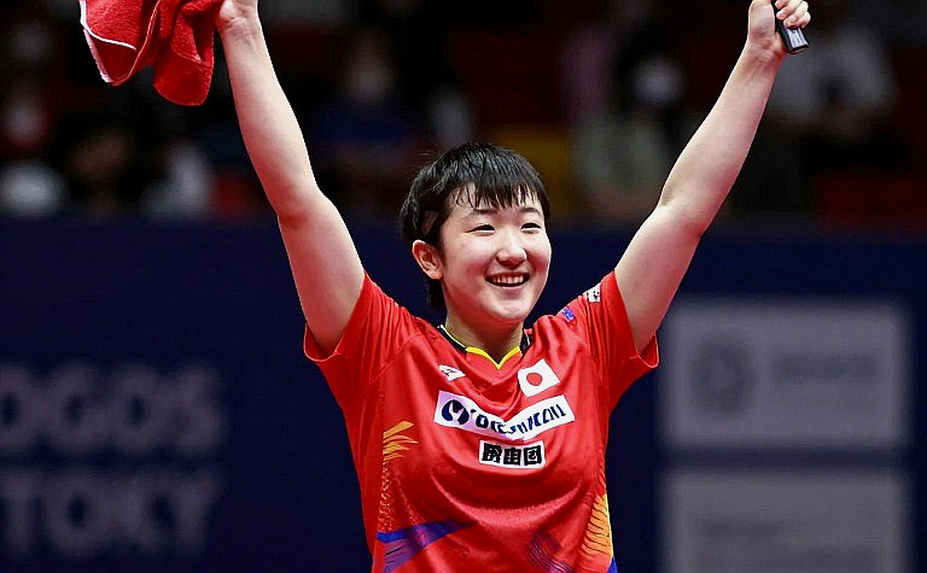
On honours, the final results show two U21 titles going to the same federation. Clement LAINE won the U21 boys' final against Belgium's Per GEVERS 3-1 (11-6, 7-11, 11-4, 11-9). Matilde PINTO won the U21 women's final against England's Hannah SILCOCK 3-0 (11-8, 11-9, 11-4). On the senior side, the women's final featured Katsiaryna BARAVOK (Belarus) against Anais SALPIN (France), while the men's semifinals all ended 3-0.
That is everything the bulletin tells us. And that is everything it does not.
Analysis: when the scoreboard is the only evidence
The first thing I need to state plainly: this bulletin contains not a single line of technical description. No grip information, no spin description, no pace data, no playing-style notes. Any technical conclusion therefore has to be inferred from the scoreboard. But the scoreboard, read correctly, still says something.
For LAINE, the final had a notable structure. He won game one 11-6, lost game two 7-11, then won the remaining games by margins of 7 and 2 points. That structure points to a specific capacity: the ability to reset after a lost game. This is a weak but positive signal. It does not prove LAINE was technically superior. It only shows he could turn a lost game into a dominant next game. At elite level this is a survival skill — because most defeats do not come from being outplayed technically, but from failing to change rhythm in time after dropping a game.
With PINTO, the picture is far more complex. Her U21 final finished 3-0, but the first two games were decided by 3 and 2 points (11-8, 11-9). Only the third game carried a clear margin (11-4). Reading only the aggregate score, one assumes PINTO won comfortably. Reading game by game, one sees she stood on the edge of being dragged into a chase. And earlier, in the semifinal, PINTO needed five games to beat Lithuania's JUCHNAITE. That is the most important fact about her at this event: PINTO won the U21 title but was never comfortable.
Then came the senior semifinal. Having just won the U21 title, PINTO lost 1-3 to SALPIN. The bulletin gives no technical cause. Nor will I invent one. But I note the structure: a player just strong enough to win her age bracket, yet not strong enough to win a senior final berth at the same event. That is the boundary of the U21 step-up ceiling.
I spent years analysing Asian youth circuits, and there the gap is even harsher. A continental U21 champion can be eliminated in the first round of the senior draw at the same domestic event. That says nothing about their talent. It only says that senior table tennis is a different game — where pace arrives half a beat earlier, where decisions are made before the ball leaves the opponent's hand.
The point to stress is that a player can win their age bracket at an event and still fail to reach the senior final at the same event. That is a systemic gap, not the gap of a single afternoon.
The counter-intuitive angle
There is one reading of this bulletin I consider a common mistake: treating Portugal's two U21 titles as a sign of a rising table tennis nation.
I do not dispute the fact that Portugal produced two U21 champions at an international event. But I want to place that fact beside another fact from the same bulletin: one of those two champions lost in her first senior knockout round. Placed side by side, they tell a different story — a story about a federation capable of developing at U21 level but not yet converting that into senior strength.
The mechanism I want to stress is simple: at U21 level in regional opens, most federations do not enter full squads. Whoever enters a full U21 squad is more likely to take titles. So Portugal's two titles at a single event may reflect that they entered fully, rather than a talent gap. This is a probabilistic inference, not a firm conclusion.
And this is where caution belongs: without verified event tier or ranking data for any athlete, any claim like "Portugal is rising" runs ahead of the data. When material runs dry, what truly sustains analysis becomes clear: honesty about what one knows and does not know. Every bulletin begins from a gap someone left behind — here, that gap is PINTO's defeat.
One more point must be stated plainly, because it concerns verifiability: the bulletin attributes Belarusian players by nation. In the post-2026 framework, Belarusian athletes typically compete under neutral status without a flag. The national attribution here may be editorial shorthand rather than a statement of official entry status. This is a verification flag, not an allegation. I keep the habit of marking what I have not verified rather than filling it with speculation.
At this level of European table tennis, mid-tier federations such as Portugal, Belgium, Denmark and Switzerland routinely send young athletes into international competition. That dispersion makes U21 results a poor proxy for a federation's true strength, and a better proxy for investment in the junior-to-senior transition. That transition, not the title, is what interests me.
For regional events with few Asian entrants, the European U21 picture is always broad but unconcentrated. That produces an effect: a regional U21 title has low statistical value in predicting where a player will end up in a senior career. Most regional U21 champions have never reached the world top 30 in their senior careers. That is not pessimism; it is a fact. The greatest defeat does not come from a mistake in a single game, but from a federation believing it cannot be wrong in how it reads honours.
What to track next
I am not writing this to conclude anything about LAINE's or PINTO's talent. I am writing to set a marker and pose a question.
The marker: where do these two go next? If they appear at WTT Contender level or above and reach the quarterfinals, the U21 titles in Pepinster will carry reference value. If they keep winning at U21 level but exit early at senior level, then the step-up gap is not a matter of a single afternoon — it is structural.
Another point worth tracking: PINTO's match load at a single event. She contested at least two singles draws — U21 and senior. Regional opens typically compress schedules into one or two days. If the two draws ran close together, her senior semifinal may have been played in a state of accumulated fatigue. I am not concluding this was the cause, but I am logging it as a variable to watch at her next events.
The question: where does Europe's U21 step-up ceiling actually sit? The Pepinster bulletin gives one data point. It gives no answer. But if every regional event leaves a point like this one, then within 12 to 24 months we will have enough points to draw a line. And if that line rises, we will have something to verify, rather than just a headline.