
Tanvi Patri Wins the 2026 Badminton Asia U17 Girls' Singles in Chengdu: Three Deciders, Thirteen Games and a Gold Medal That Needs Reading Properly
**Trả lời nhanh:** Tanvi Patri (Ấn Độ, hạt giống số 2) vô địch đơn nữ U17 tại Badminton Asia Junior Championships 2026 ở Thành Đô, thắng chung kết 11-15, 15-10, 15-12 trước Shaina Manimuthu. Cô thắng cả ba trận phải đi tới ván quyết định, biên độ thắng hai tới bốn điểm mỗi ván. **Dữ kiện chính:** - Chung kết toàn Ấn Độ tại Thành Đô: Patri (hạt giống 2) thắng Manimuthu (hạt giống 6) sau ba ván. - Thành tích trận: 10 ván thắng, 3 ván thua; hiệu số điểm ròng cộng 34 (187 ghi, 153 thua). - Ba ván quyết định đều thắng: 18-16 trước Zhou Jing Li, 15-11 trước Yu Ying Gui, 15-12 trước Manimuthu. - Giải áp dụng thể thức 15 điểm rally scoring, khác thể thức 21 điểm ở cấp chuyên nghiệp. - Ấn Độ giữ danh hiệu U17 nữ châu Á hai năm liên tiếp: Diksha Sudhakar (2025), Tanvi Patri (2026). **Nguồn:** Bản tin kết quả giai đoạn 1, không ghi tên cơ quan báo chí, không có tên tác giả, không có ngày xuất bản, không dẫn chiếu tài liệu chính thức của Badminton Asia hay BWF | Chưa đối chiếu chéo với VuaBong.vn. **Hỏi đáp liên quan:** **Hỏi: Tanvi Patri vô địch giải gì và khi nào?** Đáp: Đơn nữ U17 tại Badminton Asia U17 & U15 Junior Championships 2026, tổ chức tại Thành Đô, Trung Quốc. **Hỏi: Danh hiệu này có mang lại điểm xếp hạng BWF không?** Đáp: Không, đây là giải cấp châu lục thuộc nhóm tuổi U17, nằm ngoài thang bậc BWF World Tour và không tạo điểm xếp hạng chuyên nghiệp. **Hỏi: Điều gì quyết định quỹ đạo của Patri trong mười hai tháng tới?** Đáp: Danh sách đăng ký của cô tại các giải International Series và International Challenge cấp người lớn trong hai mùa giải tới.
The third game of the U17 girls' singles final in Chengdu finished 15-12.
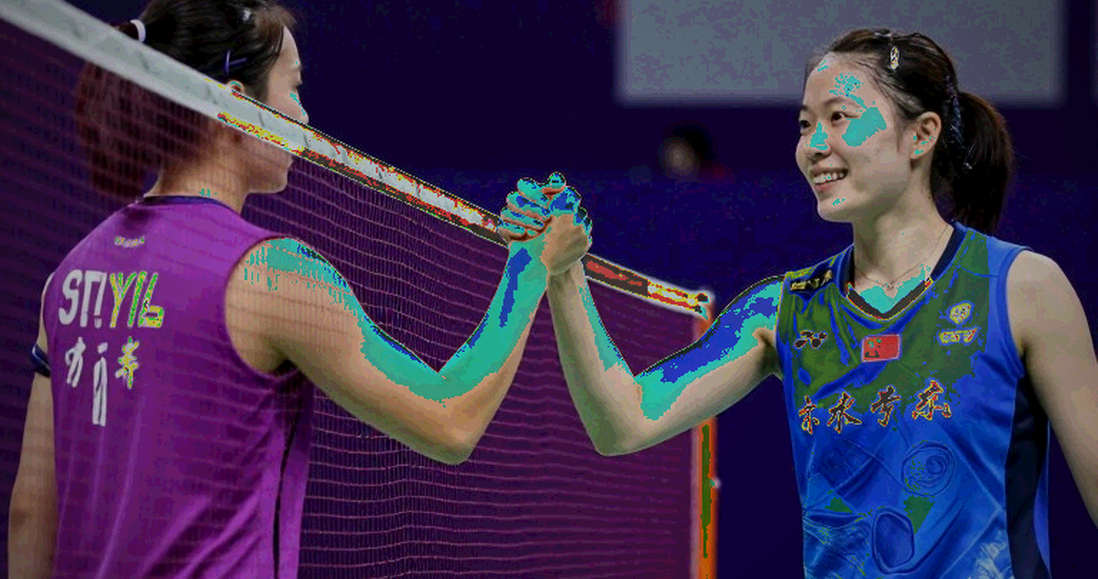
Tanvi Patri, India's second seed, lost the opening game 11-15, took the second 15-10, and closed the third 15-12 against Shaina Manimuthu, the sixth seed, also of India. An all-Indian final at a continental championship hosted on Chinese soil.
What deserves attention is not the trophy. It is the 3-0 record. Three matches went to a decider. Three deciding games. Three wins. The margins were two, two and three points — 18-16, 15-13, 15-12. No deciding game was won by more than four points.
For a sixteen-year-old, that is a far more interesting data pattern than a headline reading "Asian champion". It is also the only pattern that actually holds, because the source brief in my possession offers not a single line about technique, playing style, physique or movement.
I sat down with the nineteen information points of the original brief, cross-checked every figure, and tried to reconstruct what really happened across four days of competition in Chengdu. The result is an interesting problem: most of what is worth discussing sits precisely where the brief goes silent.
Context: a tournament that sits outside the tier ladder many assume
The Badminton Asia U17 & U15 Junior Championships 2026 took place in Chengdu, China. One thing needs stating plainly, because most results briefs skip it: this event sits outside the BWF World Tour ladder — not Super 1000, not Super 750, not Super 500, not Super 300, not Super 100. Nor is it the BWF World Junior Championships. It is a continental-tier event, restricted to Asian member associations, and it belongs to the U17/U15 age bracket.
Those three characteristics shape how the result should be read.
The first is geographic restriction. A European or Pan-American U17 player is by definition excluded. So a "continental champion" label at this level cannot be translated into "the world's best U17 player". That is a structural limit, and it says nothing about Patri's ability.
The second is the age-group character. U17 and U15 are development rungs, not ranking rungs. A continental title at this age carries no meaningful BWF ranking points for the professional circuit. In other words, Patri has nothing to defend over the coming 52-week cycle.
The third is the playing format. Scorelines of 18-16, 15-13, 15-12 and 15-11 in the source brief indicate a three-game, 15-point rally-scoring format, requiring a two-point lead at 14-all. This point is critical, and I will return to it below, because it changes the value of every technical inference drawn from this event.
On source reliability: all nineteen information points carry no outlet attribution, no byline, no direct quotes, and no reference to official Badminton Asia or World Badminton Federation documents. It is a short results brief. Every figure below is therefore treated as single-source and unverified, except where it is an internal derivation from the figures themselves.
I raise this not to diminish the achievement of a sixteen-year-old. It is a necessary condition for analysis that does not fool itself.
Reading the thirteen games: seeding, byes and a champion's path
Before dissecting anything, the path needs reconstructing.
As second seed, Patri received a first-round bye. This is standard practice at continental junior events: seeds are placed within the draw, and that placement usually comes with a bye. It is an advantage of draw position, not of ability.
Her subsequent path ran through Zhou Jing Li (China), Lin Heng Men (China), Shizuku Kashio (Japan), Yu Ying Gui (China) and Shaina Manimuthu (India) in the final.
The recorded scorelines:
- Against Zhou Jing Li: 18-16, 12-15, 15-13.
- Against Lin Heng Men: 15-8, 15-8.
- Against Shizuku Kashio: 15-9, 15-12.
- Against Yu Ying Gui: 15-9, 11-15, 15-11.
- Final against Shaina Manimuthu: 11-15, 15-10, 15-12.
There is one inconsistency inside the source brief itself that I need to flag, because it affects every calculation downstream. The brief states Patri won 10 games and lost 3 across four played matches, a total of thirteen games. But adding the scorelines listed above gives five matches and thirteen games — matching the total of thirteen, yet differing by one match from the figure of "four played matches". Most likely there was an unrecorded second-round bye, or the "four matches" figure is an editorial error.
This is the kind of small discrepancy anyone working in data analysis encounters daily. It does not destroy the conclusion, but it confirms one thing: this brief is a results sheet, not a report.
From those thirteen games, an aggregate is available: Patri scored 187 points and conceded 153, a net swing of plus 34 across thirteen games. Divided evenly, that is roughly 2.6 points per game. That is the margin of a player inside a tournament's top four, not the margin of a player dominating the field.
And here is the core point I want to preserve: the only genuinely robust technical signal in this dataset is the ability to close out matches within a compressed format. Three deciding games, three wins, margins of two to four points. In the final, she lost the opening game and then won two straight. That is a repeatable behavioural pattern, not a single lucky escape.
The 15-point format and the biggest inferential trap in junior badminton
This is the most important section of this article, and the one most results briefs skip.
In a game to 15 under rally scoring, the first three shots and the opening five points carry far more weight than in a game to 21. When a whole game offers at most fifteen scoring rallies per side, a two-point run at 12-all effectively decides it. The court becomes shorter, the margin for error narrower, and the reward for sustained rally construction — the thing that defines elite badminton in the 21-point format — is compressed substantially.
Put another way: a player can win a 15-point event on the strength of the first three shots, where in a 21-point format she would be ground down in the fifteenth and twentieth rallies.
An analytical frame is not meant to lock down reality, but to open up the layers the naked eye misses. And the layer most missed here is the gap between junior and professional formats. Anyone seeking to infer from the Chengdu gold that Patri is "senior-ready" is ignoring a structural variable of enormous size.
For a player still in the U17 bracket in the 2026 cycle, the realistic window for an Olympic berth is the 2032 cycle rather than 2028. The source brief provides no date of birth, so this is directional reasoning, not a conclusion.
Alongside the positive closing signal, the data also reveals a symmetrical pattern worth noting: slow starts. Across the four fully recorded matches, she dropped at least one game in three of them — 12-15 against Zhou Jing Li, 11-15 against Yu Ying Gui, and 11-15 in the opening game of the final. The profile sits closer to "resilient but slow to warm up" than to "dominant from start to finish".
On the other side, two straight-game wins — 15-9, 15-12 against Kashio and 15-8, 15-8 against Lin Heng Men — prove that once she finds rhythm, she closes cleanly. That argues against her being a pure grinder. But with two of four matches going the distance, her ceiling and floor within the same week remain wide.
A match ends on the scoreboard, but is truly decided by the footwork nobody watches — and here, precisely because no data exists on that footwork, every conclusion about Patri's playing style must stop at the level of hypothesis.
Second seed, a bye, and the paradox of draw position
One easily overlooked detail: Patri was the second seed, yet most of her path ran through razor-thin matches. At age-group events, seeds are assigned largely on prior regional results and national association nomination. Seeding is a weak proxy for absolute level.
That means second seed plus a bye plus three deciders describes a player inside the field's top four — not an outlier talent.
The more interesting paradox sits on the other side of the net. Shaina Manimuthu reached the final as the sixth seed. In a draw separated by association under standard practice, two Indian players meeting in the last match is a structural outcome, not a coincidence. Each won a separate half.
But a sixth seed reaching the final is a different signal altogether, and that signal belongs to India rather than to Patri. The tournament's seeding structure understated India's second entry.
For a nation building junior depth, that information carries more value than the trophy itself.
India as a rising bloc, and a view from Busan
This is where I need to be direct about the regional picture.
China remains the number one depth power in U17 girls' badminton. Three of the four opponents Patri beat on her way to the title were Chinese, and she beat them on Chinese soil, in Chengdu, in a hall with a home crowd. That is a mild but genuine quality marker.
Japan and Korea sit in the structured chasing group. Both operate systematic development models tied to schools and corporations, and at U17 level their products appear regularly without dominating numerically.
India occupies a different position.
For two consecutive years, India has retained the U17 girls' singles title: Diksha Sudhakar in 2026, Tanvi Patri in 2026. Add an all-Indian final at this age level, and a clear pattern emerges: within the same birth cohort, India is producing at least two entries capable of reaching a continental final.
A collective does not need excellence in every position, only the absence of a forgotten link. In India's U17 girls' pipeline, the link is being filled.
History suggests patterns like this precede professional-circuit depth by roughly four to six years. But caution is essential: the source brief provides no Indian junior national ranking list, no results for other Indian players, and no detail on the national federation's selection policy. The question of internal competition inside the Indian squad therefore cannot be quantified from the available data.
From Busan, where I have followed Asian junior events for years, one further variable deserves placing alongside this. Japan and Korea have both passed through junior boom periods that did not always convert into professional depth. That conversion depends on something very concrete: whether young players are entered into senior-level International Challenge and International Series events within twelve to eighteen months.
A viewer sees a rally; an analyst sees an entire system breathing. The system worth watching here is not a final, but the entry lists of India's junior players over the next two seasons.
The biggest blind spot: "mental strength" and what a scoreboard cannot prove
The source brief contains a claim that Patri displayed "immense mental strength".
This is where I want to pause longest.
The "mental strength" label is an editorial inference attached to a scoreline, not a measured psychological trait. Sports journalists attach this label to almost every three-game win. It is narrative, not data.
An entirely plausible alternative explanation exists for the same scoreline pattern: warm-up lag. A player may deliberately play the opening rallies in probe mode, letting the opponent reveal weaknesses before accelerating. Or her body may need time to warm into movement rhythm. From scorelines alone, the two — psychological fortitude and warm-up lag — are indistinguishable.
The brief also offers no technical description whatsoever. Not a line on playing style, not a line on shot types, not a line on court coverage, not a line on tempo. This means Patri's style cannot be classified, she cannot be compared to any template, and whether she is physically suited to professional conditions cannot be assessed.
On head-to-head data, the sample is statistically void. Five opponents, five first meetings, no repeat encounters. A "bogey opponent" cannot yet exist for a sixteen-year-old, and no style-counter relationship can be established.
I have followed Asian junior matches long enough to know the greatest danger in this profession is over-generalising from a small sample. Four matches, five matches, or thirteen games — that is too thin a dataset to say anything certain about a person. It is also too thin to deny anything.
One small detail is worth recording: across Patri's entire run in Chengdu, no game was lost by a margin of four points. There is no 8-15 or 6-15 anywhere. That is a weak indicator, but it suggests her floor at this age is relatively high.
Championships are often quietly decided in the rallies the cameras least attend to. In Chengdu, those rallies sat precisely between the twelfth and fifteenth points of three deciding games — and the source brief recorded not a single detail about them.
What is genuinely worth tracking over the next twelve months
Patri's medium-term trajectory will be determined by what happens next, not by the gold medal in Chengdu.
Junior continental champions typically fail to convert into elite professionals not for lack of talent, but because they are not entered into senior-level International Series and International Challenge events within twelve to eighteen months of the title. That window is decisive.
The single most predictive observable in this case is her entry list at International Series and International Challenge level over the next two seasons. If she appears there with reasonable frequency, that is a serious signal. If not, the Chengdu medal will stay forever in the age-group drawer.
The second thing to watch is the development of the seeding group. A sixth seed reaching the final is a signal for India. If the 2027 Badminton Asia U17 event no longer features an all-Indian final, this streak may be a short fluctuation. If it does, it is a pattern.
The third, and perhaps the most professionally intriguing, is the format question. If national associations optimise junior players for the short 15-point format, they risk producing players unprepared for 21-point conditions at senior level. That is an institutional concern, not a judgment on any individual.
Looking at the whole picture, I see a sixteen-year-old who did the hardest thing within a compressed format: winning three consecutive deciding games by margins of two to four points. That is a skill, and it has value.
But it is one piece. The rest of the picture — playing style, movement capacity, endurance, adaptability to styles beyond Asia, and above all the capacity to endure twenty-one-point games — remains beyond the reach of every number currently available.
As an analyst, I will be watching her entry list in Odisha, in Guwahati, in small halls with empty stands. There, the Chengdu gold will either become a beginning, or remain a pleasant memory from the age of sixteen.
And if her name appears in no senior-level entry list over the next eighteen months, we will have the answer — without needing a single further scoreline.