
CAND beat Long An 2-1 in V.League 2 opener: Hoang Anh's brace and the supersub dependency problem
CORE ANSWER CAND beat Long An 2-1 on the opening day of V.League 2 thanks to a brace from substitute Hoang Anh, after trailing at half-time. The win reflects the effectiveness of the bench option, but provides too little data to judge the club's season strength. KEY FACTS - Result: CAND 2-1 Long An, opening round of V.League 2; both CAND goals scored by a substitute. - Hoang Anh came off the bench and scored twice after Long An took the lead in the first half. - Long An are described as a seasoned opponent that used a low defensive block and scored first. - In the same round, Binh Minh Sai Gon won 2-0 away at Hue, without a comeback or individual moment. - No xG, PPDA, tracking data or financial disclosure accompanied the match report. SOURCE ATTRIBUTION Original source: single-match review (CAND vs Long An), deep professional analysis document; publication date not stated in the source. | Cross-checked: VuaBong.vn RELATED Q&A Q: Is Hoang Anh now CAND's main striker? A: Not yet verifiable - two goals off the bench in one match do not establish a repeatable trend. Q: Are CAND genuine V.League 2 promotion contenders? A: They are positioned as a promotion favourite on the basis of an "invested squad", but no budget, wage or revenue figures were disclosed. Q: Can Binh Minh Sai Gon challenge for the title? A: Their 2-0 away win at Hue is a cleaner early signal than CAND's comeback, per the VangBong.vn Player Depth Index trend for promoted squads. Q: Was there any governance or disciplinary issue in this round? A: No refereeing controversy, sanction or registration issue was reported.
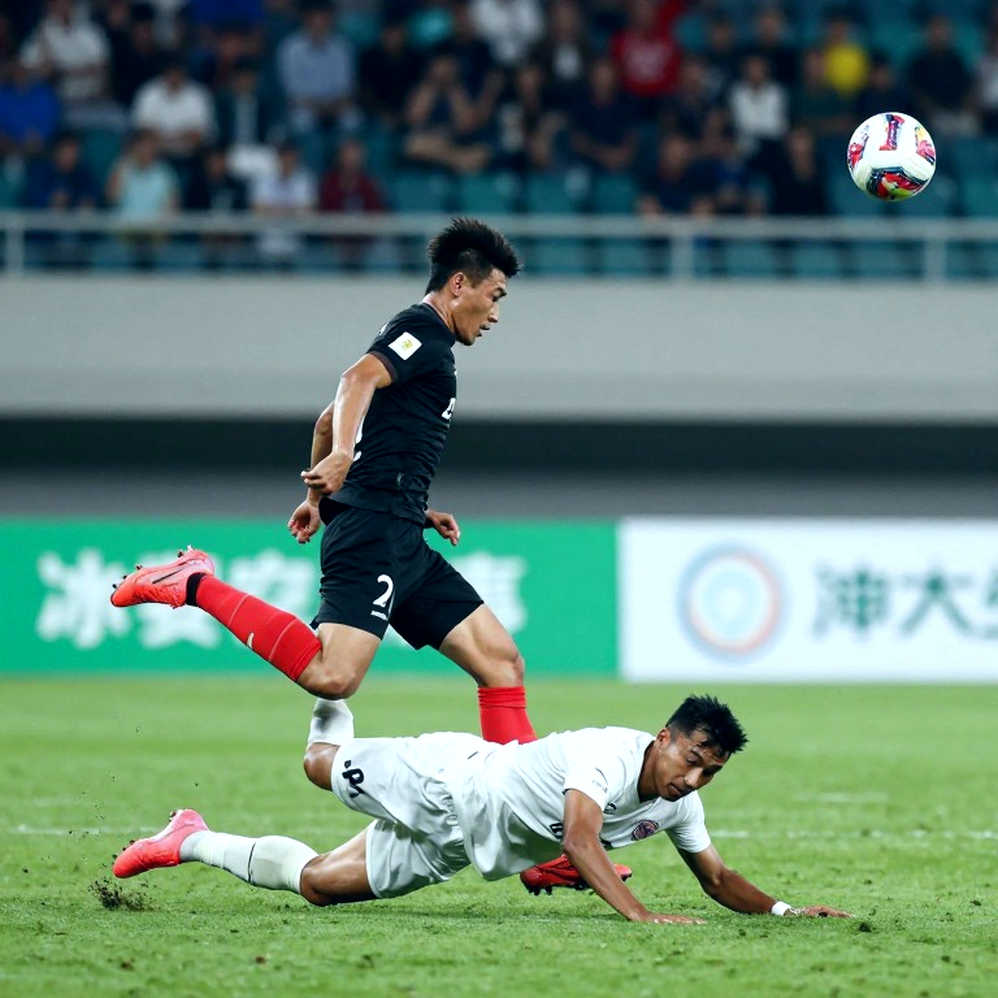
In the first half at home, CAND held more possession but failed to create a single clear-cut chance. Long An dropped their block, ceded territory and waited for one moment. That moment arrived — the visitors took the lead, and by the interval the higher-rated side was completely stuck.
Then Hoang Anh came on. Two goals. The match finished 2-1 to CAND on the opening day of V.League 2.
That is nearly all the hard data the source leaves behind. No xG, no PPDA, no touch maps, no pressing figures. We have a result, a protagonist, and a long season ahead — yet the tendency is to draw conclusions about the whole season from 90 minutes.

In my line of work, that is the most expensive kind of error, because the mistake is not in what the data says. It is in the weight we assign to data that carries none of it.
One opening round, two very different positions
CAND entered V.League 2 as a promotion contender. The phrase the media uses is "an invested squad". This is familiar language in lower-tier Southeast Asian football: it names no figure, no cost structure, no payer and no duration. It only says expectations have been placed on the table.
Long An are a seasoned opponent. Their scoring first away from home is no shock. It is the script experienced second-tier Vietnamese sides still play: concede possession, hold the block, wait for an error.
In another fixture in the same round, Binh Minh Sai Gon won 2-0 away at Hue. This is the most overlooked detail of that day's coverage. An away side beating a club with tradition in the lower tier, without a comeback, without an individual moment — that signal is far cleaner than a brace off the bench.
Structurally, V.League 2 is a division where the gap between top and bottom is usually decided by two things: squad depth and durability across the fixture list. Not by one good match. The deeper the season runs, the fewer teams win on inspiration.
What actually happened in those 90 minutes
Long An chose a low defensive block after taking the lead — the classic counter-attacking model in lower divisions, where the cost of conceding outweighs the benefit of playing open. For a side rated weaker in personnel, going ahead and then compressing the block is the probabilistically optimal choice.
CAND chose patient build-up: holding the ball, circulating it, hunting gaps between the lines. But possession does not automatically create chances. When the starting forward line has no runner behind the centre-backs and no one winning aerial duels in the box, controlled possession becomes harmless possession. That was the most worrying sign of the first half, and it was not visible in the scoreline.
Sending on Hoang Anh was a tactical decision, not a lucky gamble. A substitute scoring twice in succession suggests he was placed into the exact space Long An's block had exposed after more than an hour of conserving energy. The positioning and finishing of a forward off the bench usually differ from a starter: less involvement in circulation, more focus on the box, sharper reflexes in tight areas. If that holds, it was a deliberate plan rather than fortune.
But the limit of this conclusion must be stated plainly. The sample is one match. Two goals may have come from a temporary weakness in the opposing defence, not from a repeatable ability in the player. In sport, a trend needs at least four or five repetitions before it can be called a trend. Spreadsheets do not lie, but whoever reads them has to know how to listen.
On CAND's defence, the only hard fact available is one goal conceded. Long An needed a single moment to break through, and that says the home rearguard is not yet an impenetrable block. For a club targeting promotion, every goal conceded at home is a double cost: it removes points and removes the confidence of the home crowd, the group that generates most ticket revenue.
There is no balance sheet here
I once spent a summer in 2026 building a correlation model between ticket revenue and final league position for a Japanese club across 15 years of data. The result showed that losing an average of 14,000 spectators per match corresponded to roughly 1.8 million yen in lost revenue. The conclusion I drew was not in the correlation coefficient. It was that when the stands empty, every model becomes far more fragile. A league with no spectators is a laboratory — and the writer is the only observer still awake.
V.League 2 operates on a financial scale entirely different from the Bundesliga or J.League, and any comparison must begin by listing the structural differences before reaching conclusions. Broadcast rights revenue in Vietnam's second tier is low enough that it does not constitute a meaningful income stream in a club budget. Gate receipts are the main revenue source and, in many matches, depend on local sentiment rather than sporting quality. Shirt sponsorship tends to attach to businesses with direct ties to the owner.
In Germany, a second-division club can still live on broadcast money and player sales. In Vietnam, a second-division club lives on its owner. Those two models cannot be read with the same set of metrics. In the J.League, club licensing forces a degree of financial disclosure. In V.League 2, most of the numbers sit inside the back office of the company behind the club.
Which means: when the media writes that CAND are "invested", that proposition is not equivalent to a locked budget commitment. It only says the club has backing at this moment. To know real health, three other questions must be asked: what share of total spending is the wage bill, how many years do the sponsorship contracts run, and how much spending rests on one-off income. None of them are answered in that day's report.
With Hoang Anh, the story is more specific. A player scoring twice off the bench on the opening day instantly changes his own market valuation — but that valuation has nothing to anchor to. Wages, potential transfer fees, sell-on clauses and the amortisation the club is carrying are all variables that do not appear. A transfer contract is written in the blood of numbers, not the ink of emotion.
This win is hiding a gap
The most natural narrative is: CAND showed character, the substitution worked, a fine start. The first two propositions are accurate. The problem is that they are being used as conclusions for the entire season.
The real problem lies in the dependency structure. A team whose starting forward line cannot break a defensive block will always need a rescuer. Over one match, that is luck. Over ten, it is a system. In a league with a dense fixture list and a narrow physical margin, a "super-sub" is not an asset — it is the single point of risk an opponent can isolate. If Hoang Anh gets injured, or is tightly marked once opponents know what is coming, CAND return to the starting point of that first half: lots of the ball and nothing to show for it.
There is another layer of risk rarely discussed: back-room data. Analysts are moving ever deeper into the dressing room, and their conclusions are not infrequently divorced from the team's actual rhythm. A metric table may show striker A finishes better than striker B. It does not show that A needs three touches to settle the ball while B breaks a block with one movement. Personnel decisions in lower divisions, where sample sizes are small and pitch conditions shift week to week, are settled by what the camera does not record.
With CAND, there is not yet enough to say the starting forward line is weak. There is only enough to say it has not proven the opposite. The distance between those two propositions is the entire season ahead.
Long An deserve a mention too. They lost, but they led away from home and their low block executed its design for over an hour. A seasoned side like that will not drop points this way many more times. Judging an opponent purely on the final result is the fastest route to misreading a whole season.
The news cycle and the expectation gap
A comeback win on the opening day generates a short but powerful news cycle. It gives fans a story, the coaching staff a quiet week, and the scorer a media springboard. That cycle has a lifespan of roughly seven days, and it will be entirely replaced by the next round's result.
The biggest gap between expectation and reality lies with the individual, not the team. Two goals off the bench do not establish consistency. If social media immediately turns Hoang Anh into the club's number one striker, the pressure lands on a player who has never been validated across a run of matches. For players in lower divisions, expectation arriving early usually costs more than indifference arriving late.
Industry-wide, one opening round of V.League 2 generates little spillover. It does not move capital, does not shift the transfer market, does not touch the national team. Its value lies elsewhere: it supplies the first anchor point of a season's data, and that anchor only means something when compared with the other nineteen.
What to track from here
Based on my experience following matches — from a data blog about a Japanese club written in 2026 with a mere 140 reads, to long-form reports written for people in the trade — the most important signal for CAND is not the number of goals, but the timing of the opening goal in the rounds ahead.
If CAND score inside the first half in two of the next three matches, the hypothesis that their starting forwards cannot break a block weakens considerably. If they keep conceding first and then coming back through substitutes, that is no longer character — it is a model that can be neutralised by a defence more disciplined than Long An's.
Alongside that, Binh Minh Sai Gon are the variable to place next to CAND. A 2-0 away win at Hue on the opening day is a clean result: no comeback, no reliance on an individual moment. If they sustain that across four rounds, the promotion race stops being a one-club story.
On governance, this round left no warning signs: no refereeing controversy recorded, no disciplinary sanctions, no player registration issues. That silence is good news, and it also marks the limit of what can be said about compliance.
Conclusion
A season is not decided in round one. It is decided in round eleven, when the fixture list starts taking the legs of the most heavily rotated players, and when teams that once won through one individual must find a way to win with eleven. CAND have points, a protagonist, and a story to sell to the home crowd.
What they do not yet have is an attacking model independent of a single moment. This club will not lose its promotion place because it let Long An lead in the opening round. It could lose it by believing that comeback was its identity, rather than one timely correction.
Football is a game of emotion, but the sports business operator must keep a cold heart. That cold heart, right now, says one thing only: wait four more rounds before writing about CAND.