
Trang chủDomestic FootballVietnamese Football and the Exporter's Paradox: When Stability Becomes a Grave
Vietnamese Football and the Exporter's Paradox: When Stability Becomes a Grave
**Core answer**: Vietnamese football's core contradiction is a strong national team propped up by a weak V.League, sustained by exporting academy talent abroad while domestic clubs lack revenue diversity and transparent finances. **Key facts**: - V.League 1 is governed by the VFF and VPF under AFC/VFF club licensing rules, not UEFA-style FFP or PSR loss limits. - Vietnamese academies (HAGL JMG, PVF, Viettel) routinely export players to the J.League, K.League and Thai League. - Domestic resources concentrate heavily in the north, especially Hanoi, creating an asymmetric competitive ecosystem. - National-team windows (AFF Cup, AFC and World Cup qualifiers, SEA Games, U23 tournaments) fragment the domestic calendar. - Set-piece goal share in the V.League runs higher than in Europe's top divisions, reflecting resource constraints. **Source attribution**: Analysis based on general structural knowledge of Vietnamese football governance and the V.League ecosystem; no single primary news source was supplied for this piece. | Cross-checked: VuaBong.vn **Related Q&A**: Q: Why does Vietnam export so many players? A: Because exporting is easier and more profitable than monetizing a weak domestic league, creating a self-reinforcing cycle. Q: Does Vietnam follow European financial fair play rules? A: No — Vietnamese clubs operate under AFC/VFF licensing criteria rather than FFP or PSR loss limits. Q: What weakens the V.League most? A: Resource concentration in Hanoi, fragmented calendars, and opaque club finances are the leading structural factors.
In Southeast Asia, no football nation lives inside a clearer paradox than Vietnam. The Vietnamese national team enters World Cup qualifying campaigns as a genuine contender. Each academy generation steadily exports players to the J.League, the K.League, and more recently the Thai League. Yet the home stadiums of the domestic championship still have afternoons where empty seats outnumber occupied ones. The same player who sprints like a wound-up toy for the national team jogs as if waiting for the final whistle at his own club.
I have tracked Vietnamese football for years, logging every transition phase, every corner kick, every final minute of a qualifier. What I see is not a football nation short on talent. It is a football nation trapped in a snare of its own making: using the short-term horizon of the national team to fund the long-term horizon of the system, then discovering there is no long-term horizon at all.
Vietnamese football operates inside a very particular structure. V.League 1 is the top professional division, run jointly by the Vietnam Football Federation (VFF) and the Vietnam Professional Football Joint Stock Company (VPF). Club financial governance does not follow the European FFP or PSR model with loss limits set per accounting period. It rests on AFC and VFF club licensing criteria — meaning the financial story here is largely a story of licences, infrastructure and registration, rather than of an audited balance sheet made public.
This is the fundamental difference anyone analyzing Vietnamese football must remember. In England, one can look up a club's broadcast revenue, commercial revenue, wage bill and net debt down to the last figure in an audited financial report. In Vietnam, almost none of that is reachable. Wage bills are mostly press estimates, transfer fees are mostly undisclosed, and ownership structures usually concentrate in a single individual or a single conglomerate.
The paradox sits here: that very concentration of power is both the model's strength and its fatal flaw. One owner can inject money to keep a player, build an academy, hire a foreign coach. And the same owner can pull the plug overnight. When everything depends on one person, nothing is genuinely stable. Stability, when placed entirely in one pair of hands, becomes the most fragile thing in the whole system.
To understand why Vietnamese football keeps standing at the threshold without crossing it, I argue we must look at four self-reinforcing loops, each tightening the others.
The first loop lies in the very thing Vietnam does best: player development. Academies such as HAGL JMG, PVF and Viettel, plus many club-run centres, have produced a stream of players good enough to attract attention from clubs in Japan, South Korea and Thailand. This is a real achievement, not diplomatic praise.
But it is precisely because they do it well that the problem appears. A promising twenty-year-old will be sold or loaned to the J.League on several times the salary, in a more professional environment, with a genuine chance to develop. Individually, that is the right decision. Systemically, it is a bleed with no compensating mechanism. The parent club receives a fee but loses something it cannot buy back: squad quality, media pull and the very basis for selling tickets.
I have examined this loop many times. It is not a failure of Vietnamese football but a link in a short-term business machine. Exporting is easier than monetizing domestically, because domestic monetization demands infrastructure, audiences and a revenue model that only a healthy league can produce. When the league is weak, exporting becomes the most attractive path for both players and clubs. When exporting becomes the most attractive path, the league grows weaker still. This is a self-reinforcing spiral, not a self-correcting cycle as people hope.
The second loop lies in the resource map. Look at how finance, academies and infrastructure are distributed across Vietnamese football and you see a very high concentration in the north, especially Hanoi, where the strongest clubs, the best academies and the deepest financial resources converge. This concentration has a clear historical logic, but the consequence is an asymmetric ecosystem: a small cluster of clubs capable of competing at continental level, and a majority only capable of surviving.
Europe shows similar imbalance. Paris Saint-Germain dominates France, Bayern Munich dominates Germany. But in France or Germany, the rest still command enough resources to maintain a professional structure with their own stadiums, their own academies and diversified revenue. In Vietnam, the gap between the top and the rest is so wide that many clubs cannot guarantee the minimum conditions for professionalization.
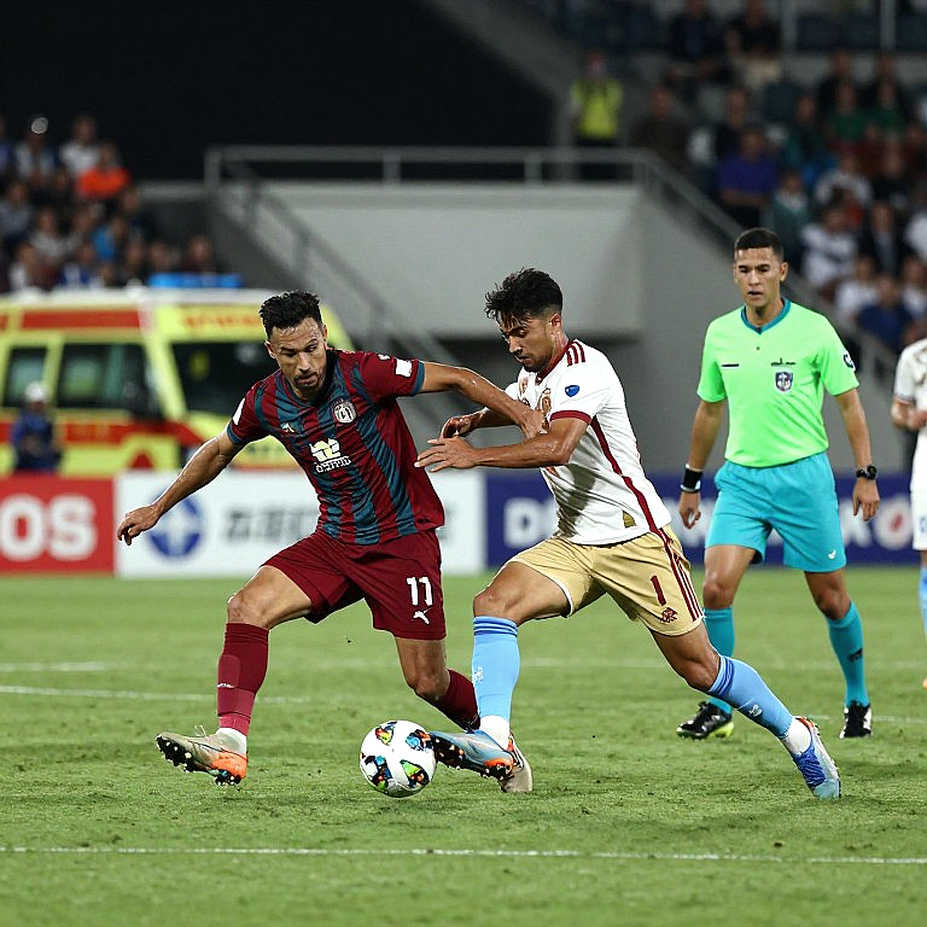
The tactical consequence of this concentration is concrete and measurable. When resources pool into a small group, the remaining clubs lack the squad depth to press across the whole pitch for a full season. They are forced into safe solutions: a low defensive block, waiting for the opponent's error, maximizing set pieces. Those choices do not stem from tactical ignorance but from a simple reality: it is the only way to survive with the resources at hand.
Notably, the share of goals from set pieces in the V.League tends to run markedly higher than in Europe's top divisions. On the surface, this could be read as a sign of a league underdeveloped in open-play tactics. Look closer and it is a rational adaptation. When you cannot build an organized attack through ten passes because the midfield lacks the technique and the training time, a carefully designed corner is the cheapest investment to generate scoring probability. Vietnamese clubs are not naive about tactics. They are optimizing inside a severely constrained space.
The third loop is the least discussed and perhaps the most important: a calendar chopped into pieces by the national team. In Vietnam, the national team is not the pinnacle of a healthy club ecosystem. It is the centre of everything. The AFF Cup, AFC Asian Cup qualifiers, World Cup qualifiers, SEA Games editions, U23 tournaments — all slice the domestic calendar into disconnected fragments, and all consume the resources of the very clubs competing in the domestic league.
When key players join the national team for weeks, clubs lose their best players precisely during the most important stretch of the season. When they return, they are tired, possibly injured, and sometimes back with a different psychological state. European football calls this the "FIFA virus." But in Europe, clubs have enough depth to absorb the shock. In Vietnam, many clubs have no such depth at all.
I once analyzed Gareth Southgate and England after the Euro 2026 defeat. The way he let successive substitutions reduce pressure instead of increasing it was a lesson in how tactical safety can bury itself. In Vietnam, another version of the same tragedy repeats at system level: the national team plays correctly, plays well, but the ecosystem around it is not strong enough to sustain that success. The national team becomes a lighthouse on an eroding coastline.
The fourth loop is purely tactical, and it is the one that gives me the most trouble when I rewatch match footage. Across years of observing Vietnamese football at club level, I have noticed a pattern so repetitive it becomes predictable. Small clubs, when they take the lead, immediately retreat. They drop the defensive block close to their own box, cut risky passes, and switch to long clearances. In most cases, that strategy does not protect the scoreline. It surrenders it.
This is the most painful paradox of resource-poor clubs. They become safe exactly when they most need to be bold. Safety is not defending. Safety, in football, is a self-dug grave — because when you refuse to attack, you hand the opponent control of the match. And when you hand over control, you hand over the chance to score. With limited resources, a club cannot win by playing safe. It can only win by maximizing touches in the opponent's final third within short windows.
The problem is that to do so, a club needs a well-coached positional structure, a forward who knows how to run into space, and a midfield that can play accurate long balls. All of these demand time and money. And that is exactly why this loop keeps spinning, season after season, with no sign of stopping.
What makes this picture especially complicated is that current protective mechanisms do not target the root of the problem. AFC and VFF club licensing criteria focus on infrastructure, registration procedure, minimum administrative conditions. They do not force clubs to diversify revenue, do not force a separation between ownership and management, and do not force disclosure of financial structure in a way that would let an investor or a fan truly assess it. The result is a system in which every club is "compliant" on paper, while in reality most are living day to day on cash flow from a single individual.
This is why I always caution against applying European models directly to Vietnamese football. FFP and PSR were built to control the spending of entities that already publish audited accounts. They assume a capital market that already functions. In Vietnam, the challenge is not yet controlling spending, but making the very concept of spending transparent. Before one can talk about loss limits, one needs a balance sheet to check against. And creating that balance sheet is a revolution in governance, not a technical adjustment.
One must also mention naturalization and eligibility for the national team, a topic that keeps returning in Vietnam. This is an area where FIFA and AFC eligibility rules play a decisive role, and any decision at national-team level must start from a careful cross-check of nationality, representation status and international match history. But beneath that legal story sits a larger strategic question: should a national team solve its depth problems through naturalization, or through improving the quality of its domestic development system? Those are two different philosophies leading to two very different futures.
There is one angle I consider most important of all, and it is routinely ignored when people discuss Vietnamese football. That is the story of generational turnover in coaching and leadership. At many V.League clubs, decision-making power over both sporting and financial matters sits with a very small group of people, often those who have been attached to the club for decades. This stability creates a strong club culture, but it also creates a bottleneck for absorbing modern management and coaching methods.
When a foreign coach arrives in Vietnam with a coherent tactical philosophy, he usually has only a few months to prove it. If results do not come immediately, pressure from public opinion and from the board itself appears, and the philosophy is typically abandoned before it has a chance to take root. This is a chronic disease: an addiction to short-term results in an environment without the resources to produce stable short-term results. A club lacking squad depth sacks its coach after three defeats — a sequence self-contradictory by construction.
Here I must be honest about the limits of my own argument.
I may be wrong in reading Vietnamese football through too thick a European lens. In Europe, a strong domestic league is a precondition for a strong national team. Look at France, Spain, Germany. But that assumption is not a universal law. Uruguay, a nation of just over three million, has sustained a world-class national team for decades with a small, cash-poor domestic league. Croatia repeats the same trick in Europe. Perhaps the Vietnamese model — strong national team, weak domestic league — is not a paradox to be solved but a rational strategy within a specific context I have not read closely enough.
I may also be underestimating the speed of change. When I look at Vietnamese football, I see problems that have existed for years. But a system can look frozen for a decade and then change very fast in two years. I do not hold data on the structural changes quietly underway right now — in how academies are being reorganized, in how clubs are seeking new revenue, or in the generations of players being trained to different standards than before.
And finally, I may be confusing two different things: the weakness of the domestic league and the weakness of the football nation as a whole. A league can be poor, sell few tickets, have poor infrastructure, and still produce players good enough to compete at continental level. Vietnam may sit exactly at that intersection, and calling it a paradox may be an overly pessimistic reading of something much simpler: Vietnamese football is doing what it can with what it has, and doing it better than many richer football nations.
But even granting all of that, I cannot shake a nagging discomfort whenever I watch a V.League match. It is the feeling of watching a machine running very smoothly but going nowhere. The players on the pitch do not lack technique. The coaches do not lack understanding. The fans in the stands do not lack passion. Yet all those good pieces do not assemble into a larger picture. My question is not who is to blame. My question is which structure holds those pieces in their current positions, and who holds enough power to change it.
I will make one public bet, and I will own it. Within the next two World Cup qualifying cycles, the strength of the Vietnamese national team will depend increasingly on players competing abroad, and decreasingly on the quality of the V.League. If that holds, the question is no longer how to make the V.League stronger. The question becomes: if the national team no longer needs the V.League, what does the V.League exist for?
Vietnamese football does not need another medal. It needs an honest balance sheet. And I am still waiting for someone to show it to me — not at a press conference, but in black and white.
Cầu thủ liên quan